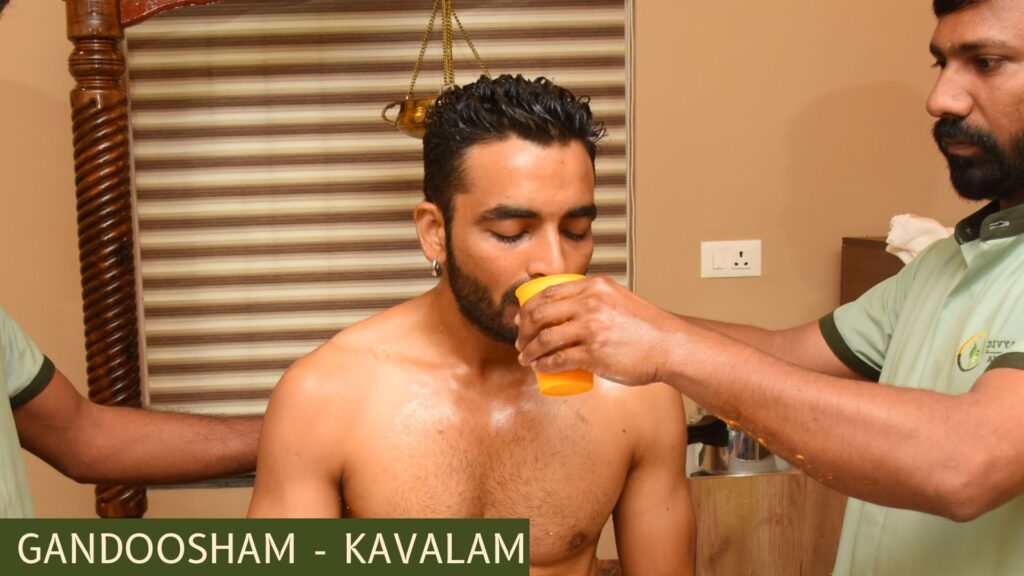
Gandhoosham (Gandusha) and Kavalam (Kavala) are two Ayurvedic oral cleansing therapies that involve holding or swishing medicated liquids (such as oils, herbal decoctions, or medicated water) in the mouth. These therapies are highly effective for maintaining oral hygiene, strengthening teeth and gums, detoxifying the oral cavity, and preventing systemic diseases.
According to Ashtanga Hridaya and Charaka Samhita, these therapies help in eliminating Dosha imbalances in the mouth, throat, and head region, especially Vata and Kapha disorders.
Gandhoosham (गण्डूषं) – The mouth is completely filled with liquid and held for a specific duration without movement.
Kavalam (कवलं) – A smaller quantity of liquid is used, and the person swishes it around before spitting it out.
Both therapies work as Danta Poshaka (tooth nourishing), Mukhadhvikaara Hara (oral disease eliminators), and Vishahara (detoxifying agents).
1. Sneha Gandhoosham (Oil Holding Therapy) Uses medicated oils like Til Taila (sesame oil), Arimedadi Taila, or coconut oil. Indications: Dry mouth, weak gums, and Vata-related oral disorders. Benefits: Lubricates the oral cavity, strengthens teeth and gums, and prevents cracking or dryness of lips.
2. Shamana Gandhoosham (Palliative Therapy) Uses cooling herbal decoctions such as Triphala Kashaya, Yashtimadhu (Licorice) decoction, or Dhanyamla. Indications: Mouth ulcers, stomatitis, and burning sensation in the mouth (Pitta disorders). Benefits: Soothes inflammation, heals ulcers, and improves taste perception.
3. Shodhana Gandhoosham (Detoxifying Therapy) Uses strong astringent and cleansing herbs such as Haritaki (Terminalia chebula), Musta (Cyperus rotundus), and Saindhava Lavana (rock salt) decoctions. Indications: Excessive salivation, Kapha accumulation, and foul breath. Benefits: Detoxifies the oral cavity, removes bad breath, and prevents infections.
4. Ropana Gandhoosham (Healing Therapy) Uses medicated ghee or cooling oils such as Go-Ghrita (cow ghee) or Brahmi Ghrita. Indications: Post-dental surgery care, gum bleeding, and severe mouth dryness. Benefits: Heals damaged tissues, prevents infections, and strengthens oral mucosa.
The patient is advised to brush their teeth using herbal powders or Triphala Churna. The selected medicated oil or herbal decoction is warmed to body temperature. The patient is seated in a comfortable position in a quiet environment.
For Gandhoosham (Gargling Therapy):
The patient takes a large quantity of the medicated liquid and holds it in the mouth without movement.
The liquid is retained until the eyes start to water or the nose begins to release mucus (a sign of Kapha clearance).
The liquid is then spit out complete
This process is repeated 2–3 times for a total duration of 5–10 minutes.
For Kavalam (Oil Pulling Therapy):
A smaller amount of liquid is taken and swished around vigorously for 3–5 minutes.
The person continues to move the liquid through the mouth to pull out toxins (Ama Vishodhana).
The liquid is spit out when it changes color (usually turns whitish).
The process is repeated for 5–15 minutes as needed.
/p>
The mouth is rinsed with warm water or herbal decoction. A pinch of Saindhava Lavana (rock salt) mixed with turmeric can be used to rub the gums. Avoid consuming food or drinks for 30 minutes after therapy to allow the medicinal effect to continue.
Gandhoosham and Kavalam are powerful yet simple Ayurvedic oral therapies that can be incorporated into daily routines for long-term dental and oral health. These therapies not only cleanse the mouth but also support digestion, respiratory health, and neurological well-being. Regular practice of oil pulling (Kavalam) and herbal gargling (Gandhoosham) can prevent gum diseases, bad breath, and even systemic disorders.